Apiculture Mini Series Part 3: Buzzing Ahead in Honduras
This is Part 3 of 3 of our Apiculture Mini Series. Check out our other stories:
Apiculture Mini Series Part 1: Empowering Rural Women Beekeepers Across Bolivia
Apiculture Mini Series Part 2: Building a New Generation of Environmental Leaders in Colombia
Context
In Comayagua, Honduras, the Cooperativa Apícola Pionera de Honduras Limitada (COAPIHL) – the Pioneering Beekeeping Cooperative of Honduras – is leading the way for beekeepers across the country.
“Just like our name, we are pioneers,” states Tomás Medina, General Manager of COAPIHL.
With nearly 90 beekeepers, including women and members of the Lenca Indigenous community, COAPIHL stands out as the only government-certified beekeeping cooperative in the region. Its commitment to producing and marketing high-quality Honduran honey and locally made beekeeping equipment has positioned it as a leader in a sector facing increasing economic and environmental pressures.
Limited government support for honey producers in Honduras has weakened market protections over the past decade, creating an influx of counterfeit honey into the market and causing challenges for legitimate producers. At the same time, climate change has intensified the spread of pests and diseases, threatening hive health and compromising both the quantity and quality of honey.
In response, COAPIHL partnered with Catalyste+ in 2017 and joined the Accelerating Women’s Empowerment (AWE) Project in 2020. Over the past nine years, Catalyste+ and COAPIHL have worked together to strengthen the cooperative’s capacity, foster innovation, and expand market opportunities.
COAPIHL & Canadian Knowledge
One of the most impactful collaborations between COAPIHL and Catalyste+ took place in 2023, when then–General Manager Juan Carlos participated in a South-North assignment with Catalyste+. Traveling from Honduras to Canada, he worked with Catalyste+ Advisor Peter Keating, visiting six honey and bee-product plants across Quebec. Together, they met with plant owners and engaged in in-depth discussions on honey production, commercialization, and quality control, exploring how Canadian practices could be adapted to the Honduran context.
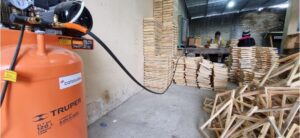
A compressed air tank purchased through the AIMf powering a pneumatic nailer used by a female COAPIHL member to build bee boxes and frames.
The trip provided a critical insight: the transformative impact of investing in machinery and equipment to improve production flow and efficiency. In Honduras, most equipment manufacturing processes remained manual. Seeing automated systems in Canada highlighted a clear opportunity for COAPIHL’s growth.
“With machinery and equipment] we could produce more, reduce costs and therefore prices to our consumers, and improve our cooperative’s image,” shares Juan Carlos. “These changes would allow us to grow as a company.”
Motivated by this vision, COAPIHL applied for Catalyste+’s AWE Innovation Micro-fund (AIMf) to bring these lessons home.
The AWE Innovation Microfund (AIMf) is a gender-focused initiative aimed at strengthening women’s economic empowerment through the acquisition of supplies or equipment. The fund is dedicated to partners who have benefited or are in the process of benefitting from technical assistance with one of our Advisors, so that they can better apply their newly acquired knowledge and skills, or implement assignment recommendations.
Within three months, COAPIHL received funding and purchased pneumatic tools, including hygrometers, nailers, staplers, and compressors. These tools were immediately put to use in the production of beekeeping equipment, such as bee boxes and frames. With this innovation, COAPIHL furthered its ‘pioneer’ status.
“With the support of the micro-fund, we have become the first beekeeping cooperative in Honduras to use pneumatic tools for product manufacturing,” reported Juan Carlos. “It has improved operational efficiency, product quality, and productivity.”
Before the AIMf, COAPIHL staff had to hammer each nail manually, a slow and physically demanding process that limited productivity and female participation. With pneumatic tools, setting a nail now requires just the press of a button, resulting in a 40% increase in productivity. The upgrade also enhanced product durability, customer satisfaction, and workplace safety, as operators now wear protective equipment like gloves and face fewer risks of injury.
Pneumatic tools are handheld or powered tools that run on compressed air instead of electricity. They’re known for being lightweight, powerful, and durable, especially in industrial or workshop settings.
These advancements directly benefited COAPIHL’s 12 operators (seven men, five women), who also received a 6.5% salary increase as a result of the improved efficiency and increase in production. Moreover, the tools were accessible to male and female operators alike. While women are already an important part of apiculture in Honduras, the equipment removed physical barriers in the development of the bee boxes and frames, enabling women to participate as equal contributors. Since receiving the AIMf, female association members have become more confident in their skillsets and comfortable making decisions for the association. This has led COAPIHL to involve more women in leadership roles, advancing gender equality and strengthening women’s leadership within the organization.
Product Diversification
Beyond improving the production process, the Canadian visit also sparked innovation. While touring several companies in Canada, Juan Carlos was struck by the wide range of honey-based products being produced in the industry.
“I was able to see all of the honey-based products these companies in Canada sell, including marinades, vodka, gin, wine, beer, soaps, cookies, flavored honeys; just hundreds of honey-based products,” shares Juan Carlos. “I realized that there are so many more products we can create.”
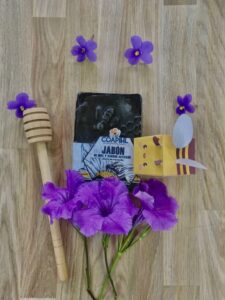
Artisanal chamomile and charcoal soap created by COAPIHL’s women members.
To help COAPIHL begin diversifying, Catalyste+ Advisor Rhéal Lafrenière provided targeted support. Rhéal delivered a presentation to four COAPIHL members on creamed honey production, outlining the required steps and equipment, and also shared training materials on beeswax candle making for the team to review independently. During his visit, Rhéal discussed the importance of involving women in these innovative production efforts with the COAPIHL leadership team, highlighting the potential economic benefits for both the association and the women’s families.
COAPIHL’s leadership team shared this knowledge with women members of the cooperative, expanding their technical capacity and role in product development. Over the following months, 14 female members of COAPIHL put this guidance into practice. Together, they developed flavored creamed honey, artisanal soaps, and candles, complementing the cooperative’s traditional honey products. Following Rhéal’s advice, the cooperative also installed a cold room to strengthen the creaming process and extend shelf life. The new products were marketed as “women-made,” celebrating female leadership and reinforcing COAPIHL’s brand identity.
By 2025, these innovations combined with gender-conscious marketing had driven significant growth in sales. The women involved saw their incomes increase by 25%, gaining greater financial autonomy and involvement in decision-making. Their families also experienced improved access to education for children, better nutrition, and improved housing conditions, contributing to a higher overall quality of life. Within the community, these women have become role models, encouraging others to become involved in beekeeping and entrepreneurship.
Climate Change Resilience
During his visit, Catalyste+ Advisor Rhéal Lafrenière also provided guidance on pest management, given the rise in recent years due to climate change.
Working with 32 women and 88 men, Rhéal emphasized the importance of preventative measures, such as regular hive inspections, hive sanitization strategies, and comb rotation, rather than relying on the corrective measures the cooperative had previously used. When bees showed signs of disease, Rhéal taught beekeepers how to identify key indicators to diagnose specific parasites or illnesses and apply appropriate treatments.
“Before the assignment, members were misidentifying whether bees had diseases or not,” shares current General Manager Tomás Medina. “This resulted in them buying and using expensive medicine even in cases where it was likely unnecessary. With the Catalyste+ Advisor, beekeepers learned how to properly inspect the bees and determine whether they were actually diseased. This has given them greater control over whether or not to spend their funds on medicine.”
This new knowledge not only reduced unnecessary spending for association members but also strengthened their ability to manage pests and diseases in their apiaries. As a result, COAPIHL reported a 70% increase in apiary health, fewer hive losses, and improved honey quality. Moreover, the preventative measures implemented reduced members’ reliance on chemical treatments, aligning with the association’s environmental goals.
While climate change and its related pests and diseases remain a critical issue in the region, the techniques from Advisor Rhéal have enhanced COAPIHL’s resilience to it.
“The techniques learned have empowered the Lenca group by improving their capacity to manage pests and diseases in their apiaries”, states Tomás. “Climate change is impossible to control, but with this assignment, [the beekeepers] have better techniques to manage its effects. This helps in a huge way.”
Conclusion
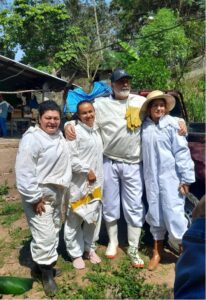
Catalyste+ Advisor Rhéal Lafrenière in the field with three female COAPIHL members.
The Cooperativa Apícola Pionera de Honduras Limitada and Catalyste+ illustrate how long-term partnerships and knowledge exchanges can create meaningful, locally driven impact.
The South–North assignment provided a valuable opportunity for learning and reflection, adapting Canadian expertise into practical innovation in Honduras. From the introduction of pneumatic tools to the development of new bee products, COAPIHL has reinforced its pioneering role in the sector, with women at the lead.
At the same time, Catalyste+ has helped COAPIHL become better equipped to face the growing challenges of climate change. While environmental pressures continue to affect beekeeping in Honduras, the cooperative’s enhanced pest and disease management practices have improved hive health and reduced losses, strengthening members’ ability to adapt and protect their livelihoods.
Looking ahead, COAPIHL remains focused on sustainable growth, expanding its market presence, and exploring new opportunities. Built on innovation, inclusion, and environmental sustainability, the cooperative is well positioned to continue shaping a stronger and more equitable future for beekeepers in Honduras.
Acknowledgment
Catalyste+ would like to thank Brianna Marshall for leading the creation of this impact story, as well as Claudia Aparicio, Graciela Galeano, Patricia Oliva, Tomás Medina, and Rhéal Lafrenière whose valuable inputs contributed to this publication.