Reconciliation Action Plan Update for 2026
In the second year of implementing our Reconciliation Action Plan (RAP), we continue to reflect, learn, and challenge ourselves as an organization and as individuals. One part of our RAP commitment is to update the Catalyste+ community on this progress. More importantly, though, our RAP commitment is a promise to be accountable to Indigenous Peoples.
Progress is complicated when it comes to reconciliation. It implies that we’ll have measurable steps toward a defined end goal. But that doesn’t align with the reality or complexity of this initiative. That lesson has been hard to digest with a group of high achievers who excel in the face of challenges and are motivated by our achievements.
Put simply, we don’t get to define success; only Indigenous communities can. We can, however, acknowledge the steps we’re taking in the spirit of reconciliation.
We hold two truths in tension: our efforts matter, and so does historical context.
Meaning, we can recognize the changes we’ve made, like resource allocation, new and updated policies, and our dedication to listening to understand better the current realities and challenges Indigenous People face in Canada. And we must also acknowledge that while these changes may feel significant to us, they represent the fairness that should have existed centuries ago.
Let’s not confuse good intentions with a job well done. We have plenty left to do.
This past year, we’ve worked hard to overcome inertia. Change on this level isn’t easy. It’s inconvenient. It forces us to challenge norms, call out prejudiced behaviours and practices, and admit the areas where we’re falling short. It’s hard.
Our resistance isn’t an unwillingness to change; it seems rooted in uncertainty.
We feel the anxiety that comes with challenges that have no clear path to success. The fear of not getting it right can stall progress. We’ve seen that in our own journey.
RAP Timeline
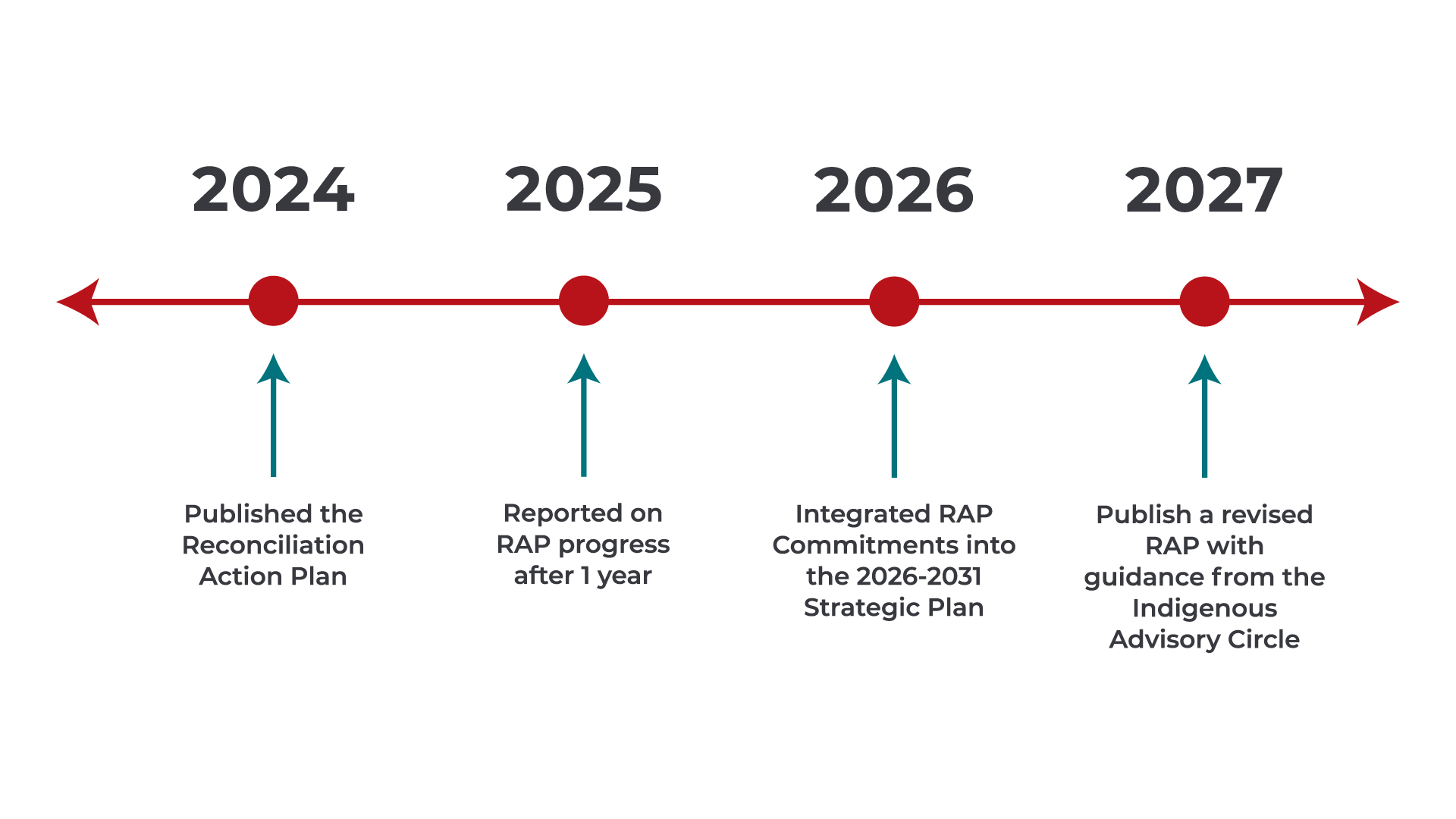
In last year’s update, we acknowledged our natural inclination to get things done efficiently and realized reconciliation can’t be treated the same. Our priority for the year was to clarify our reconciliation intentions, which we’ve done.
We also identified the need for an Indigenous Advisory Circle to help guide us forward. Though we didn’t reach our target, we’re close to finalizing the group’s participants and aim to hold our first session in early 2027.
There are layers to change. On the surface, we see the measurable activities: tasks completed, number of assignments, and the like. The biggest changes, though, happen below the waterline. As our views and beliefs shift, so does our capacity to nurture relational trust and safety with Indigenous Peoples. It affects how we approach our work, how we speak about it, and how we carry the spirit of reconciliation into other areas of our lives.
This kind of change happens in the heart.
When reflecting on our RAP, the question is not only, “What did we complete?”, but also “How are our decisions, relationships, and workplace changing?
What do we think and say about the rights holders and Indigenous People?
Are things actually changing in our organization?
What is getting in the way of our intentions? Fear? Pride? Something else?
How am I as an individual unlearning, relearning, and growing?
Not everything we do feels noteworthy or like something we can check off a list. We may not think to report it, but every effort towards reconciliation is meaningful.
Reconciliation is lived through daily practice. The RAP is only a mechanism.
The action plan provides structure, direction, and documentation. It’s a record of our commitments and the steps we have taken, and will continue to take, to reconcile with First Nations, Inuit and Métis people. Reconciliation includes unlearning biases and assumptions that influence our decisions, practices, and actions.
As we enter the RAP’s third year, our priority is to deepen our commitment, as an organization and as individuals. Commit to making changes. Commit to giving more of our time and effort. Commit to rethinking and revising our norms. Commit to stepping into the challenge, even though success isn’t promised.
Messages From Catalyste+ Staff
One major lesson I’ve been gradually untangling within myself is the internal struggle of not wanting to mess up. Trying so hard not to say the wrong thing or do the wrong thing has been, in itself, holding me back from learning and understanding and walking alongside my Indigenous peers.
I learned not to take it personally or be offended if Indigenous People don’t trust me in our first conversation or what I’m offering them through our services. There is a history there that is outside of me that needs to be acknowledged….It takes time and trust to build the relationship, no matter how good your intentions are. You always have more to learn.
Over the past couple of years, I’ve become more interested in the challenges and realities of Indigenous Peoples in Canada, and I’ve made an effort to educate myself by reading articles, doing research, and trying to understand how my work connects to these issues. I still find it difficult to understand the practical ways I can contribute to reconciliation, but learning more feels like a tangible step.
Most of the time, one can only imagine what people have gone through and what could be a trigger. I learned that I should come from a place of curiosity and empathy to build instead of do harm. I know I will make mistakes, but I hope to be better and do better as I learn.
Only in the last couple of years have I started to understand the current issues and their lasting impacts. For me, reconciliation starts with understanding what happened, and then walking forward together toward a better future for all.
I appreciate Catalyste+’s efforts towards Reconciliation. I am proud to be part of an organization that observes Orange Shirt Day in a way that allows for reflection and attendance at local events. This way, as an ally, I can offer support for the Indigenous community members who are mourning and healing during this time.
Over the last year, I have had the opportunity to learn more closely from Indigenous colleagues and speakers. I am grateful for the knowledge shared to better understand where they are coming from and acknowledge the toll it takes to carry this responsibility. There is more to be done to continue healing and (re)building trust, but I’m hopeful we are on the right path.
We must keep questioning how to focus our efforts: on visible surface activities or the all-encompassing spirit of reconciliation. The truth is that neither cancels the other; meaningful progress requires investment in both.
It forces us to reevaluate how our economic development model applies to our work with First Nations, Inuit and Métis people. We often view it as a linear process: capacity-building via skills and resources leads to economic opportunity, which results in economic growth. But there’s more to consider.
The spirit of reconciliation requires a different approach. Our model, then, must be a two-way street. It’s a mutual knowledge exchange where we also learn Indigenous customs and history, and understand their current realities.
The beauty of the Catalyste+ Advisor model is that every assignment has the potential to be active, on-the-ground reconciliation work. It can help build trust, strengthen advocacy for Indigenous self-determination, and practice respectful, reciprocal ways of working with the nations.
Catalyste+ is a meeting place for this to happen.
We hold this role with humility and a sense of responsibility. With clear intentions and a near 60-year history of partnering with Indigenous Peoples, we see how our reach and influence can create and foster opportunities to advance meaningful reconciliation.
Our focus for the year ahead is to make deliberate decisions, enact new policies, and practice changed behaviours, keeping future generations in mind. We can nourish the soil and build systems so deeply embedded that they endure long after our current plans expire. Like planting a tree whose shade we may never enjoy, our responsibility is to tend to the sapling’s health and its environment.
We recognize that whatever we accomplish today won’t undo centuries of colonial history. Indigenous communities may see changes that feel significant to our organization as obvious and long overdue. Both perspectives are valid.
Healing and renewed relationships with Indigenous Peoples require honesty, trust, consent, and a shared agreement to walk together, in a good way.
How Canadians Can Support Reconciliation
Purchase an Orange T-Shirt or an Orange Hoodie to honour the children, survivors, families and communities impacted by the residential school system.
Refer Indigenous connections to join the Catalyste+ Advisor community.
Connect with our Indigenous & Northern Services team to explore ways to support our reconciliation programs.
Request an Indigenous Catayste+ speaker for your special event or faith group.
Research and write proposals to increase resources and funding for our reconciliation programs.
Support Indigenous business whenever possible, like a few Catalyste+ partners.
Attend the monthly lunch-and-learns that are offered by the INS team.
Review the Truth and Reconciliation Commission Calls to Action.
Seek out stories that are by and about Indigenous people to humanize the journey and learn about the many nations and cultures.
Donate Today
Your donation helps connect businesses, governments and community organizations with the skills and support to achieve their goals and contribute to inclusive growth. When you give to Catalyste+, you empower women and drive progress in harmony with nature. You’re helping people get what they need to improve their lives and build strong communities.